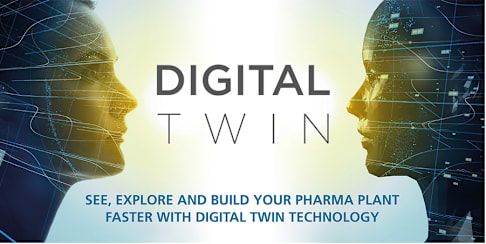
Digitalization is affecting the way many industries work and operate, perhaps none more so than the highly regulated and quality-dependent pharmaceutical manufacturing sector. Key to future progress in this industry are activities such as getting new chemical entities to market and creating novel medicines to treat rare diseases and address as-yet unmet patient needs. Here, for example, intelligent digital solutions such as artificial intelligence (AI) and in-silico trials have the potential to reduce both development times and absolute cost.
“Because of the advances that have been made with computer processing power and digital simulations, the pharmaceutical discovery, development and production landscape has been completely transformed and significant progress is already being achieved,” notes GEA’s Dr Harald Stahl, Senior Director of Innovation and Strategy, Pharma and Healthcare.
“The combined ability of activities such as process modeling, computational fluid dynamics for liquid applications, discrete element method (DEM) simulation for solid dosage forms and the evolution of digital twins is enabling researchers throughout the life sciences industries to do things that were completely impossible just a few years ago. These technologies mean that drugs — based on both small or large molecules — can be developed and scaled-up using much lower quantities of the expensive and complex active pharmaceutical ingredient (API).”
Cause and Effect
From price regulation and time restrictions to cost reductions and more, pharmaceutical manufacturers face a number of challenges on a daily basis. Yet, necessity can often stimulate innovation! Advanced digital solutions play a crucial role in achieving the process optimization that can help innovator organizations to meet these challenges and create new opportunities. One such solution that is proving to be a game-changer across the industry is digital twin technology. For example, digital twins can be used to improve process robustness and, subsequently, lead to OPEX savings by increasing OEE.
Dr Jim Holman, Technology Management Director, Pharma Solids, comments: “The use of in-silico testing and digital process simulations is gaining interest within GEA’s customer base because we can plan, test and optimize an entire process with minimal cost to the end user. In addition, simulation technologies can be used to predict how a formulation behaves during the production process, consequently reducing both time-to-market and cost. The real-world benefit is that modeling can be done using very little material or API, the tests take minutes as opposed to hours … and the results can be used to determine the operational limits of the processes and equipment being used, which actually makes them more reliable and cost-effective.”
“This is where digital twins and industry drivers such as continuous manufacturing (CM) are going hand-in-hand,” adds Richard Steiner, Global Sales Director, Continuous Technologies: “Although the often limited amount of available API during early-stage development can make physical testing difficult at a relevant scale, modeling and simulations can optimize and expedite the process transfer and scale-up of NCEs to commercial-scale production on machinery such as GEA’s ConsiGma® 4.0 platform, as well as proving the robustness of the procedure. In fact, it’s even possible to work on three digital twins in three separate time zones … offering 24/7 functionality.”
“In summary,” concludes Jim: “the benefits that can be achieved with process simulations such as the use of digital twins include reducing development and delivery times, increasing productivity and decreasing the requirement for large quantities of expensive APIs during the early stages of product development. Furthermore, it could even provide more time between patent approval and loss of exclusivity for high-value products. Not only are such applications more environmentally friendly, if all the development stages of a product can be modeled in the virtual world, we are witnessing the growth of digital — as opposed to physical — testing during the critical stages of solid dosage development.”
References
- www.mckinsey.com/industries/pharmaceuticals-and-medical-products/our-insights/the-road-to-digital-success-in-pharma#.
- www.europeanpharmaceuticalreview.com/article/51733/pharma-digitalisation-challenges
Definitions
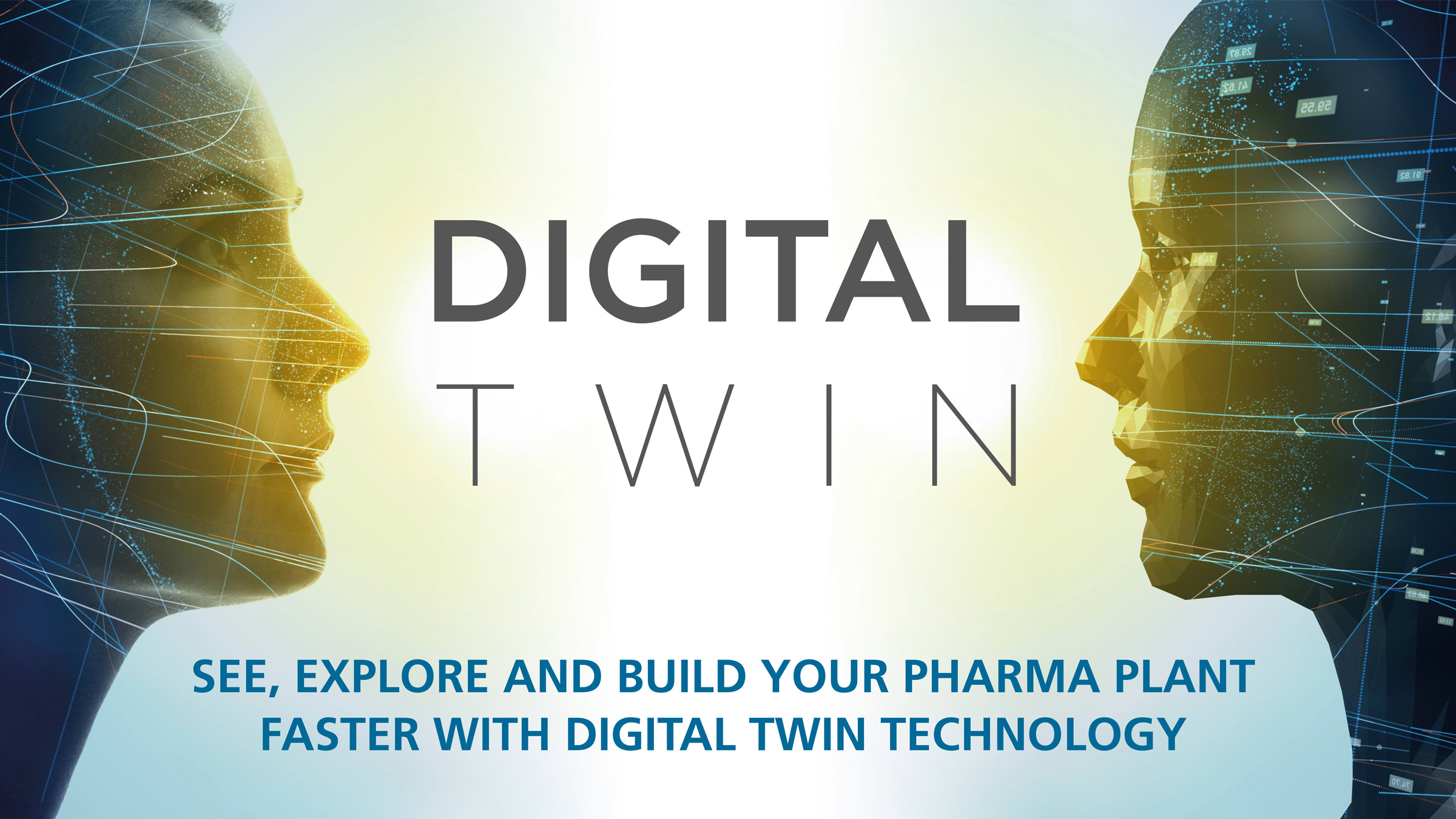
A digital twin is a software-based virtual replica of the complete physical assets of a production facility, including its process equipment, instrumentation and controls, as well as the manufacturing processes taking place within the plant, such as chemical reactions and fermentation. Using this replica, the operation of these assets is modeled and simulated throughout their lifecycles.
Process modeling is a technique designed to understand and describe a specific procedure or workflow. Often represented graphically as a flowchart or data-flow diagram, it connects and improves the communication between the current and the future state of the process as a way to identify potential improvements.
Discrete/Distinct Element Method (DEM) Simulation
Closely related to molecular dynamics, DEM comprises a family of numerical analysis and data methods to compute the motion and effect of a large number of small particles. Using high-power computers and nearest neighbor sorting algorithms to numerically simulate millions of particles, DEM provides an effective method to address engineering problems in granular and discontinuous materials.