Case story: Better Tablet Production.
Wanting to improve the production quality of both new and existing (OSD) products, Merck Sharp & Dohme Corp. has implemented a strategic initiative to invest in continuous manufacturing (CM) solutions and shift its product supply chains towards a single-piece flow model.
BETTER TABLET PRODUCTION. Wanting to improve the production quality of both new and existing (OSD) products, Merck Sharp & Dohme Corp. has implemented a strategic initiative to invest in continuous manufacturing (CM) solutions and shift its product supply chains towards a single-piece flow model.
GEA.com
It consistently delivers a higher quality product, considerably reduces time to market and complies with the increasingly stringent manufacturing acceptance criteria put in place by the regulatory authorities. With a specific requirement for a continuous direct compression (CDC) tablet production line, Merck Sharp & Dohme Limited (MSD), the UK subsidiary of Merck Sharp & Dohme Corp., turned to GEA Pharma & Healthcare, a leading provider of pharmaceutical manufacturing technology.
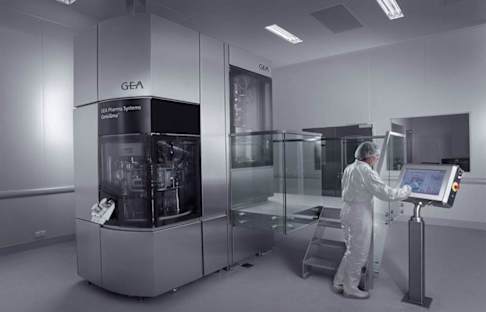
Now that the continuous processing of pharmaceuticals has moved out of the laboratory and into production environments, questions regarding the capability of the equipment to reliably and compliantly produce high quality product for long periods of time have been raised. Providing a conclusive answer to these questions, a MSD/ GEA collaboration conducted a successful robustness run on the ConsiGma® CDC50 (CDC120LB2-MS), a compact, all-in-one, tablet production line for direct compression formulations, for a period of 120 hours.
The trial run was monitored using a suite of tools, including the high-frequency measurement of more than 100 process and environmental parameters, such as spectroscopic analysis of the powder blend and physical testing of finished product; soft sensors were used to predict critical quality attributes (CQAs).
Particularly noteworthy was the use of an advanced process model to predict tablet potency and accept or reject tablets at the end of the production line. This advanced control strategy was developed by characterizing the Residence Time Distribution (RTD) of each blending stage using Near Infrared Spectroscopy (NIR) techniques with a GEA Lighthouse Probe® embedded within the production line.
By the end of the 120-hour trial, more than 15 million tablets had been made using approximately 6200 kg of raw material in a single production area. Importantly, final analysis indicated that the campaign length could be increased even further and run for longer. Benchmarking against a typical batch process, producing the same quantity of tablets would have required 10 separate campaigns and taken a team of operators working in parallel in three production areas for 5–7 days.
Summary statistics revealed that greater than 99.2% of the production met or exceeded CQAs specifications, and less than 0.5% of the tablets were out-of-specification. Additionally, production uptime of 97% demonstrated reliability that exceeded industry benchmarks, and reconciliation above 99% showed good accountability of raw material and finished product. In conclusion, the 120- hour campaign achieved the goal of demonstrating the capability of continuous manufacturing to reliably, flexibly and compliantly produce high quality drug products on demand.
Asked about the specific goals of the trial, Dr James (Jim) Holman, Senior Director Technology Management, said: “The 120-h run had been on the books for some time. We wanted to test the robustness of the technology and find out if and when it goes wrong, what happens. As it transpires, the run went fantastically well. No one expected a fault-free experience and there were some issues with the PAT (the motor that retracts the probe for cleaning). Beyond that, though, we — and MSD — also wanted to examine how the feeders, blenders and the tablet press would hold up, how routine procedures would manage and/or be affected during a long process.”
Continuous manufacturing is a superior and cost-efficient technology with a very small footprint.
2 Better tablet production.
For more information GEA Pharma & Healthcare pharma@gea.com gea.com/contact
© GEA Process Engineering nv 2022. All rights reserved. Subject to modifications.
“One thing of note,” adds Jim, “was the minimal amount of yield loss during the overall run; it was something like 0.05%. The plus points were that we got a huge amount of data that proves that the tablet press is capable of manufacturing tablets within Six Sigma control brackets for 120 hours. The levels of control were well and above what we could have hoped for. The feedback we had from MSD is very pleasing, especially as they said they wouldn’t expect such an impressive performance using other tablet presses.”
Somewhat ironically, Jim describes the last 2 days of the trial as “quite boring” as the equipment functioned so well. “We had two people from GEA and two from MSD on every shift; during the last 24 hours, there was just one person to handle the materials and take routine samples. And even that role
is something that could be eliminated on a system with automatic tablet sampling and materials handling. So, you’re getting down to an operation that, actually, doesn’t really need anyone in the room all the time. It just runs,” he commented.
In conclusion, Jim notes: “It was very successful and everyone was exceptionally happy with it. Based on the trial, we currently have a minimum of two peer-reviewed papers due to be published. The first one will be on the overall run itself, the yield, the control philosophy, how the control system works in terms of rejection and monitoring the end product. The second one will focus more on the feeders, looking at the quality data that can be obtained, how that can be used to track raw material variability and optimize the process, for example.”
Continuous fluid bed technology “An often-overlooked aspect of the standard configuration of the granulation and drying modules in a GEA CM line is the segmented fluid bed (FB) dryer. Not only does this work in exactly the same way as a conventional FB, it’s also compatible with batch lines and third-party equipment. Furthermore, its compliant with current GMP and regulatory requirements.”
Being segmented, the plant actually dries the granules in “batches” of 1 kg. “There’s a very good reason for this,” says Jim: “If the PAT quality control technology receives an out-of-specification signal, only the material in that specific segment is discarded. With a standard non-segmented FB, the entire batch would be lost. When you consider 1 kg versus the 6200 kg that was processed during this trial, that kind of setback could be catastrophic.”
3 Better tablet production.
https://www.youtube.com/GEAPharma https://www.linkedin.com/showcase/gea-pharma-&-healthcare https://twitter.com/GEAPharma https://www.facebook.com/GEAPharma
GEA.com