Making Bilayer Tablets
To reduce capital investment, modified tablet presses are used to develop and produce such tablets; however, to manufacture quality bilayer tablets and overcome issues with layer separation, insufficient hardness, inaccurate individual layer weight control, cross-contamination between the layers, reduced yield, etc., the process should be done using purpose-built machinery.
GEA.com
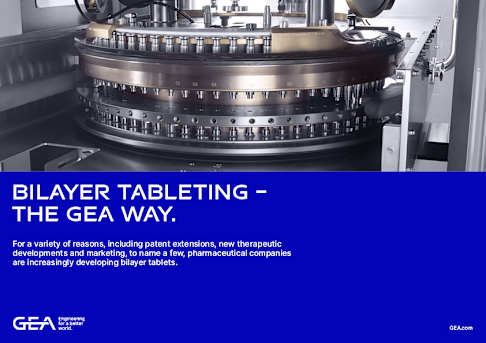
BILAYER TABLETING – THE GEA WAY. For a variety of reasons, including patent extensions, new therapeutic developments and marketing, to name a few, pharmaceutical companies are increasingly developing bilayer tablets.
To reduce capital investment, modified tablet presses are used to develop and produce such tablets; however, to manufacture quality bilayer tablets and overcome issues with layer separation, insufficient hardness, inaccurate individual layer weight control, cross-contamination between the layers, reduced yield, etc., the process should be done using purpose-built machinery. Using a modified tablet press may not be the best way to produce a quality bilayer tablet under GMP conditions, especially when high production output is also required.
Making bilayer tablets with a standard press can be difficult. The majority of double-sided tablet presses with automated production control are limited by their use of compression force to monitor and control tablet weight: separation of the two individual layers is often a problem — a consequence of insufficient bonding between the two layers during final compression.
It is essential to measure the weight of each layer independently to ensure the correct drug delivery profile; however, most tablet presses can only accurately assess weight when a high force is applied. High forces result in
dense tablets that are difficult to bond together, making separation of the layers, or capping, almost inevitable.
GEA’s tablet presses have been specifically designed and developed for the high-speed production of quality bilayer tablets and provide: • displacement weight monitoring/control for accurate and independent weight control of the individual layers
• low compression force exerted on the first layer to avoid capping and separation of the two individual layers
• increased dwell time at pre-compression of both first and second layer to provide sufficient hardness at maximum turret speed
• maximum prevention of cross-contamination between the two layers
• a clear visual separation between the two layers • maximized yield.
The GEA process uses tablet height at pre-compression to calculate weight, not force applied. This means that the weight can be calculated accurately at low compression forces, leaving the final bonding of the two layers and the density control to be achieved at main compression.
How it’s done The unique GEA method is both simple and effective. It uses the Air Compensator-derived dual control system to measure the height (and, therefore, the weight) of the first layer at pre-compression. The main compression force for the first layer remains relatively low. The second layer is then filled on top of the first layer and the height is measured at pre-compression in the same way. Main compression of the second layer bonds the layers together and measures the force applied to calculate the hardness of each bilayer tablet. This process provides very accurate weight control of each layer, ensures optimum bonding and provides the consistent hardness required. Bilayer tablet production using this unique method is available on the GEA NexGen Press® and PERFORMA tablet presses.
Benefits • Accurate weight control for both layers at pre-compression
• Effective bonding • Accurate tablet hardness control at main compression.
BILAYER TABLETING – THE GEA WAY. GEA’s tablet presses have been specifically designed and developed for the high-speed production of quality bilayer tablets.
2 BiLayer Tableting – the GEA way.
GEA.com
© GEA Process Engineering nv 2025. All rights reserved. Subject to modifications. NexGen Press®® is registered as a trademark in several countries worldwide.
GEA Pharma & Healthcare GEA Process Engineering nv Bergensesteenweg 186, B-1500 Halle, Belgium
Tel +32 2 363 8300 pharma@gea.com gea.com/contact