MUPS Q&A
Recent Q&A from MUPS webinar
GEA.com
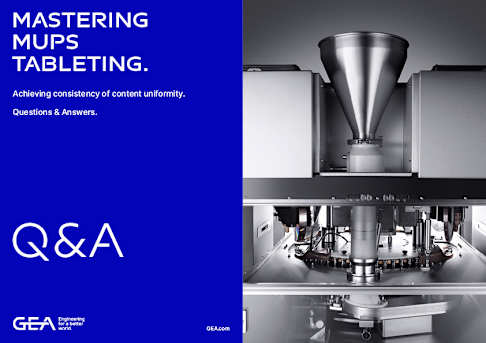
MASTERING MUPS TABLETING.
Q&A
Achieving consistency of content uniformity.
Questions & Answers.
Q1 In the MUPS presentation, the pictured installation has two floors and the room height is quite high. If our production room is not as tall, would we need to build a new facility?
A1 An integrated MUPS installation can be fed by gravity (IBCs on upper floor) via intermediate buffers or by vacuum loading: In both cases, the required height under the ceiling is 4.3 meters.
Q2 Between vacuum and gravimetric filling, what is the better option and in what situations can vacuum filling be applied?
A2 The pellets and extra-granular material are fed separately to the continuous blender system using LIW feeders. Refilling the LIW feeder hopper can either be done from the ground level via vacuum transfer or from above via gravity. Both options are equally suited and the final decision mainly depends on customer requirements.
Q3 Why would you change the pellet-to-powder ratio between compression runs?
A3 During production, the feeding ratio between pellets and excipients should be kept constant at all times and as defined in the formulation.
Q4 How do I control the process when compressing MUPS tablets?
A4 Please contact your local GEA Pharma office or email wim.verbrugge@gea.com for further information.
Q5 How does the overfill cam selection process differ in MUPS tableting compared with normal tableting?
A5 When using a single paddle feeder, the overfill is reduced to 1–2 mm instead of the 3–5 mm typically used with a standard double paddle feeder.
Q6 Why is only a single paddle feeder used for MUPS instead of the usual two or even three chambers?
A6 By using a single paddle feeder, the residence time of the material inside the feeder is reduced. As such, there is less risk of segregation and attrition of the pellet coating.
MASTERING MUPS TABLETING — Q&A.
Q&A
2 Mastering MUPS Tableting — Q&A.
Q7 Is there a standard ratio for compression (turret speed to force feeder speed)?
A7 There is no specific ratio as this is formulation- dependent (flowability, tablet size, etc.). The feeder speed is set to a minimum by using the single paddle configuration, which allows much lower feeder speeds to be used compared with the standard double paddle feeder (minimizes pellet attrition).
Q8 Can a double-sided rotary press be used?
A8 Although, in most cases, our MUPS dosing and blending technology is used on single-sided GEA tablet presses, the PDV valve and the single paddle feeder solution can also be used on a double-sided rotary machine.
Q9 How do I ensure blend uniformity?
A9 Blend uniformity (BU) is not measured inline. It can only be assessed by taking tablet samples to check the content uniformity (CU).
Q10 How do I control the powder feed rate for MUPS?
A10 The feed rate is controlled by the gravimetric feeders mounted on a weighing scale. Based on tablet weight, press speed and the pellets-to- powder ratio, a throughput setpoint is sent to each of the feeders by the tablet press control system. During production, the feeders will continuously monitor the loss-in-weight and adjust their screw speed(s) to make sure the throughput remains on target.
Q11 What are the chances of overblending or rupturing the pellets if I use ribbon blending?
A11 The ribbon blender is a low shear type mixer that puts minimum stress on the powder and pellets. The residence time of the material inside the blender is also rather low; as such, no problems with overblending have been observed (although the lubricant was already mixed with the excipient). Attrition of the pellet coating can be prevented by ensuring that there is enough space between the ribbon and the side wall of the blender.
Mastering MUPS Tableting — Q&A.
Q&A
3 Mastering MUPS Tableting — Q&A.
Q12 What type of blender should I use to mix excipients with pellets?
A12 Low shear convective blenders are best suited for this purpose, such as the ribbon blender used in the GEA solution.
Q13 In terms of efficiency, does the mass require external preblending or is the ribbon blender itself sufficient?
A13 Our test set-up in Halle typically uses two LIW feeders. We are currently working with one that delivers the cushioning agent — which is preblended with a lubricant — and a second one that supplies the pellets (sometimes preblended with a glidant to prevent the formation of agglomerates). We have also run some tests during which all the components are fed separately, which were also successful. The low-shear ribbon blender is certainly suitable for gently mixing the pellets and powder. It can also be used to blend in some lubricant, which doesn’t require a lot of energy.
Q14 Is there a fixed punch head size GEA presses or will I need a larger flat-head punch?
A14 GEA uses standard tooling. Plus, on GEA tablet presses, the dwell time is programmable and can be increased up to 250% while maintaining the same machine speed.
Q15 How do I determine the blending time using a ribbon blender?
A15 The set-up comprises a combination of dosing, blending and compression. Each step needs to be validated, preferably by exploring the design space. We can, of course, guide you through this process. Please contact your local GEA Pharma office or email wim.verbrugge@gea.com for further information.
Q16 Will I need a different screw feeder size for bulk density materials?
A16 Yes, the size of the screw mounted inside the gravimetric feeders depends on the material density and desired throughput. Exchanging these screws, however, is quite straightforward.
Mastering MUPS Tableting — Q&A.
Q&A
4 Mastering MUPS Tableting — Q&A.
For more information
Wim Verbrugge Director Sales Pharma Solids Compression Technology GEA Pharma & Healthcare +32 2 363 8300 wim.verbrugge@gea.com gea.com
Q17 As every tablet is unique, how should my sampling technique be designed?
A17 This is a general challenge in formulations with a high tendency to segregate. Currently, and as far as we are aware, there is no inline technique available that can accurately assess the API content of tablets such as MUPS; as such, quality control must rely on the evaluation of a subsample of the tablets. It is therefore important to explore the design space of the dosing, blending and compression stages of the production process (QbD) and evaluate their impact on the tablet quality. Once the optimal settings are found and validated, production mainly relies on keeping the manufacturing conditions steady (feeding ratios, maintaining a constant blender level, controlling compression force, etc.) with regular sampling to confirm tablet quality.
Q18 Can the MUPS system be retrofitted to existing tablet presses?
A18 Yes, this system can be retrofitted to any GEA tablet press that’s already in production. To discuss the details of such a retrofit project, please reach out to us.
Mastering MUPS Tableting — Q&A.
Q&A
5 Mastering MUPS Tableting — Q&A.
GEA.com
© GEA Process Engineering nv 2025. All rights reserved. Subject to modifications.
GEA Pharma & Healthcare GEA Process Engineering nv Bergensesteenweg 186, B-1500 Halle, Belgium
Tel +32 2 363 8300 pharma@gea.com gea.com/contact