Containment Case Studies
Within the pharmaceutical manufacturing industry, the need to handle highly potent ingredients and materials such as oncology drugs and hormone treatments is increasing. As a result, there is a stronger focus on operator health and safety, which puts containment at the heart of solid dosage production. As a designer and supplier of systems that protect operators, the environment and the product, GEA Pharma & Healthcare is committed to meeting the varied demands of our customers.
GEA.com
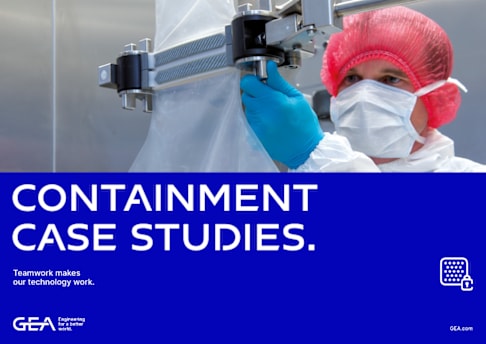
CONTAINMENT CASE STUDIES. Teamwork makes our technology work.
UNDERSTANDING CONTAINMENT.
Within the global pharmaceutical manu- facturing industry, the need to handle highly potent ingredients and materials such as oncology drugs and hormone treatments is increasing. As a result, there is a stronger focus on operator health and safety, which puts containment at the heart of solid dosage form production. As a designer and supplier of systems that protect operators, the environment and the product, GEA Pharma & Healthcare is committed to meeting the many and varied demands of our customers.
Even for experienced users, however, the selection, placement and implementation of suitable containment equipment can be a daunting task. It requires an in-depth understanding of the overall process to ensure that the chosen equipment performs at the necessary level and, from a financial point of view, to prevent any expensive and unnecessary investment into an over- performing solution.
GEA not only offers the largest variety of robust and compliant hardware solutions for contained materials handling, it also boasts unrivaled expertise in identifying the most appropriate solution and a thorough understanding of containment risk analysis.
As demonstrated in the following case studies, GEA can assist and advise you to determine what level of containment is required where and when, optimizing the manufacturing process and making it efficient, safe and cost-effective. We provide tailor-made containment for the pharmaceutical industry — for now and for the future.
2 Containment Case Studies.
Wishing to maximize the solid dosage production of a highly potent hormonal product, a leading drug manufacturer tasked GEA Pharma & Healthcare with significantly increasing their output, providing a safer and more efficient factory environment and introducing new systems that would replace the existing isolator-based process.
The challenge for GEA was to use their product flow and containment expertise to remove as much isolator-based processing as possible, making the production flow more efficient whilst maintaining the high levels of containment and operator safety required. Another key factor was maintaining blend homogeneity.
GEA first demonstrated a patented high containment system, the MODUL S rotary tablet press with a Wash-off- Line (WOL) Exchangeable Compression Module (ECM). GEA also demonstrated the use of multi-tip tooling: using two tips per punch (station) doubled the tablet press output. A specially designed feeder with dedicated software ensures optimal output.
GEA then demonstrated their ability to successfully blend the low levels of API with poorly flowing excipients. This was achieved using the company’s blending Prism technology, a very effective aid to the bin-blending process.
The new system was fast-tracked; the preliminary details were agreed within 4 months and the equipment was delivered less than one year after contract signing. Removing much of the isolator-based processing and expanding into the new factory space has enabled a significant increase in both batch size and yield, and improved the overall working environment.
Direct Compression of Hormonal Tablets.
3 Containment Case Studies.
After conducting extensive market research, Penn Pharma (now PCI Pharma Services) identified an increased need in the solid dose oncology market for the outsourced development and production of highly toxic drugs.
Its production site had been manufacturing potent solid dosage products for more than 20 years but needed additional capacity. Penn Pharma elected to work with GEA Pharma & Healthcare because of its proven track record in containment technology and expertise in terms of creating fully integrated production lines.
GEA’s approach was to eliminate the use of isolation suits in favor of containment interfaces (BUCK® MC valves and Hicoflex®).
The plant now houses the first commercial PharmaConnect® “through the wall” system in Europe. The contained R&D line for wet granulation also includes
• the dispensing of excipients and potent powders • GEA’s PMA 150 and FlexStream 1000 for
granulation and drying, dry milling, granule collection and blending
• tablet compression using a MODUL P tablet press with a Wash-off-Line ECM (Exchangeable Compression Module) and pellet coating.
The plant also has a contained R&D line for direct compression and a separate process chain that offers containment interfaces for powders, API and excipient dispensing, dry milling and powder collection and blending.
Penn Pharma is now a single source for the development and production of highly toxic drugs at one of the world’s most advanced and efficient facilities. The project has significantly increased their capacity and the company can now manufacture approximately 500 additional batches during a standard two-shift operation.
Fully Integrated, High- Containment, Contract Drug Development and Manufacturing.
4 Containment Case Studies.
GEA supplied a complete containment line to Ranbaxy Laboratories Limited (Gurgaon, India) to manufacture highly potent anticancer drugs with an OEL of 1–10 μg/m3.
It was essential that the process prevented any cross- contamination in the production area and limited operator Real Daily Intake (RDI) of hazardous substances to well within the Acceptable Daily Intake (ADI) level.
During the selection process, several key equipment features were specified: • all units had to provide full containment • the entire process had to be contained in a single
machine to avoid contamination and limit material handling
• the technology had to be flexible enough to adapt to different products and batch sizes
• the process should provide maximum yields with minimum wastage
• there should be a clear and straightforward documentation procedure.
In addition, it was essential that the operators had an in- depth understanding of both the equipment and the relevant containment issues.
To meet their production, containment and whole-life cost requirements, Ranbaxy chose two single pot processors from GEA: the UltimaPro 10 and the UltimaPro 75 (10 L and 75 L processing bowl, respectively).
The safe, low temperature vacuum drying technology was augmented with microwaves or Transflo (gas-assisted vacuum drying); end-point determination was achieved using a torque sensor (granulation) and NIR (end humidity); a built- in camera allowed operators to view the process without opening the lid; and cleaning was done by a comprehensive fully validated clean-in-place (CIP) system.
The equipment has allowed the company to develop niche oncology products in a contained environment that protects its workforce and the wider environment from toxic compounds. Since installation, predicted levels of production, containment and operational efficiency have been achieved.
In addition, factors such as very effective microwave drying for aqueous feeds, more consistent granule sizes and much less operator intervention than had been anticipated have been cited as “areas of exceptional performance.”
Lalit Sood, Projects Director for Ranbaxy, said: “The unit cost reduction has opened up the market and enabled the company to provide a hard-to-resist proposition worldwide. The GEA technology gives us security of outcome with the guaranteed quality and consistency we need.”
Top-End Containment Line for Anticancer Drugs.
5 Containment Case Studies.
When GEA Pharma & Healthcare supplied a complete oncology manufacturing line to a customer in India, they didn’t just ensure the health and safety of the operators — complying with internationally recognized standards — the company also increased yields, reduced production cycle times and implemented an ultimate containment solution.
Zydus Cadila intended to improve its solid oral dosage form production processes for highly potent drugs. Planning to use high containment equipment, the company approached GEA who recommended the use of two single pot processors in a set-up that met all the key requirements: • for the development laboratory, an
UltimaPro 10 equipped with Hicoflex® technology for containment
• for production, an UltimaPro 75 equipped with Hicoflex® and BUCK® MC valves.
Both single pot processors were equipped with all the available drying techniques, including microwaves, to ensure flexible processing, higher yields and shorter cycle times.
GEA was able to supply the company with a complete oncology manufacturing line. The entire project was managed in-house, beginning with a risk analysis regarding the amount of containment required, progressing through the overall design of the building and solution to installation and start-up.
By choosing the UltimaPro 10 and 75, equipped with all the available options, and with Hicoflex® technology and BUCK® MC valves, Zydus Cadila has ensured that it will be able to produce OEB 3 and 4 drugs in a safe, cGMP-compliant environment and guarantee maximum yields with reduced cycle times.
An All-in-One Solution for Oncology Tablets.
6 Containment Case Studies.
High-Containment Tablet Compression.
Servier, Ireland, invested in three high- containment MODUL S tablet presses with WOL-ECM.
The raw material is delivered in IBCs, which are lifted above the press with a post hoist. The material is fed into the press through a split butterfly valve (SBV).
A custom-designed high-containment Pharma Flex deduster (Pharma Technology Inc.) was installed for dedusting and to check for metal particles, including a buffer system that releases the tablets into an IBC after every Combi-Test tablet check.
Accepted tablets are collected in an IBC, which is connected via an SBV, whereas rejected tablets are taken to a closed bin.
A separate Kraemer-Elektronik washable high-containment Combi-Test tablet weight, hardness and thickness tester performs automatic tablet sampling and measuring for batch reporting and process control.
7 Containment Case Studies.
Optimized Containment for the Compression of Highly Potent Solids.
In response to increasing demand for the need to process highly potent active pharmaceutical ingredients (APIs), an established GEA customer has cultivated a center of excellence for this application at its site in Münster, Germany.
Tablet compression is, from a containment and processing standpoint, one of the most challenging unit operations in oral solid dosage (OSD) form manufacturing. The rapidly growing requirement in recent years for contract manufacturing, particularly in the OSD sector, has meant that CMOs need to have an even greater ability to produce a huge variety of products at an economical speed, even when they comprise challenging formulations.
Additionally, specific health and safety challenges arise when potent APIs are processed, requiring the use of equipment that combines very high flexibility with increased productivity and appropriate containment performance. GEA’s MODUL rotary tablet presses meet these criteria at the customer’s Münster site.
From procurement to production With nine sites in Germany, Italy, France and Japan, the company is one of the largest European pharmaceutical contract development and manufacturing companies. A full range of services — from development and materials procurement to production, packaging, logistics and distribution, including customized solutions — is offered for almost all dosage forms.
In addition to the processing of conventional APIs, the company develops and produces various specialty products, such as cytotoxics, hormones, beta-lactam antibiotics (penicillin/cephalosporin) and narcotics. The Münster site specializes in the production of highly effective and low- dose preparations such as oral contraceptives, thyroid hormones and narcotics.
Batches from 1–400 kg can be handled and services range from development activities via scale-up and clinical trial supplies to routine manufacturing. More than 2.5 billion single unit doses per year, including film-coated and sugar- coated tablets, are produced. The facility meets current US FDA requirements for medicinal products in the US market.
Keeping containment compliant As most of the APIs handled require special attention from a health and safety point of view, the entire site was designed according to EU Directive 89/391 EEC. Among other requirements, this implies that containment is ensured solely by engineering methods; personal protective equipment (PPE) is only used in the case of an emergency and/or as a last resort. This philosophy is seamlessly taken from dispensing all the way through to compression and coating.
The factory has been built to meet a design occupational exposure limit (DOEL) of 0.01 μg/m3. The DOEL was selected based on the mix of products to be processed. This includes sex hormones such as ethynylestradiol (EE). All equipment was selected based on its containment performance according to standardized measurement of equipment particulate airborne concentration (SMEPAC) tests.
Although most of the equipment used to complete unit operations such as granulation, drying or blending have been designed to operate at acceptable levels of containment, the transfer steps were a potential area of concern. A decision was made to use Müller drums in combination with GEA’s BUCK® MC split butterfly valves. Owing to its mechanical complexity, the tablet compression process demanded special attention; as such, decided to use GEA MODUL presses were recommended..
Continued on next page
8 Containment Case Studies.
For more information GEA Pharma & Healthcare pharma@gea.com gea.com/contact
MODUL press range The MODUL is GEA’s flagship product. It combines typical GEA features, such as extended dwell time — which enables the compression of difficult formulations at reportedly unbeaten speeds — with the exchangeable compression module (ECM) concept. The ECM is completely isolated from the remainder of the machine, contains all product-contact parts and can be easily removed from the press in a contained way for off-line washing.
This means that the press itself remains powder-free and requires no cleaning. Benefits include the possibility of fast changeovers, which is especially important when new products need to be processed, plus excellent containment performance.
A positive experience The Münster site has assessed the containment performance of its two MODUL S presses by measuring particle load in the production environment under operating conditions. The two presses produce a huge number of tablets. When the turret of the single-sided press is equipped with BB tooling, it is able to produce up to one million tablets per hour.
Additionally, the presses can have a replacement turret fitted in less than two hours to accommodate a product changeover. In the process, all product- contact parts are removed in a contained manner. Owing to the high containment performance, cleaning of the remainder of the press and room is not required.
A second ECM and any peripheral equipment are brought to the compression area and allow production to resume in less than two hours. The first set of parts is then cleaned off-line in a dedicated washing area, with no interference to manufacturing.
After a successful placebo-based site acceptance test (SAT), the presses were taken into real-life production and air samplings were performed for an assessment of their containment capability. Sampling heads were placed close to the most critical areas, which had been identified by a risk analysis. Taking into consideration the full range of products, seven series of tests were done, each consisting of a total of 26 individual measurements. Out of these, 23 results were below the detection limit, which is 0.001 μg/m3. In three cases, product was detected, but the amounts found were well below the DOEL.
9 Containment Case Studies.
https://www.youtube.com/GEAPharma https://www.linkedin.com/showcase/gea-pharma-&-healthcare https://twitter.com/GEAPharma https://www.facebook.com/GEAPharma
GEA.com
© GEA Process Engineering Ltd 2022. All rights reserved. Subject to modifications.