Integrated Materials Handling
Integrated process systems not only offer containment, but also provide improved productivity through automation, increased yield and efficient cleaning procedures. And, today’s increased demands for customized design, special construction materials, surface treatments, advanced control systems, compliant production and process validation have resulted in continuous improvements in solid dosage plant design for the pharmaceutical industry.
GEA.com
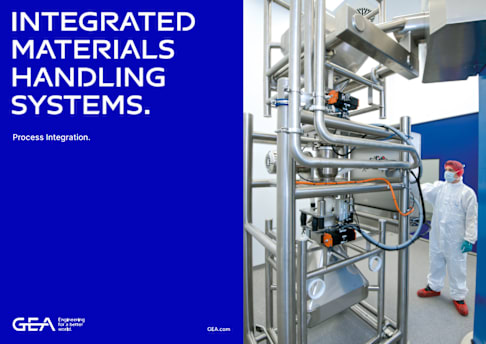
INTEGRATED MATERIALS HANDLING SYSTEMS. Process Integration.
PROCESS INTEGRATION.
Integrated process systems not only offer containment, but also provide improved productivity through automation, increased yield and efficient cleaning procedures. And, today’s increased demands for customized design, special construction materials, surface treatments, advanced control systems, compliant production and process validation have resulted in continuous improvements in solid dosage plant design for the pharmaceutical industry.
Integration by Design GEA is uniquely qualified to provide integrated pharmaceutical process lines. Drawing on its world-class expertise and technologies, we offer an entire range of cutting-edge process equipment that has been designed and built with system integration in mind. A modular approach allows customers to select standard process modules to suit specific project needs.
Plus, fully integrated turnkey installations can also be supplied, including fluid bed process equipment combined with top- and bottom-drive high shear mixer-granulators with integrated contained materials handling, wet and dry milling facilities, product handling systems, binder and coating preparation units, filtration units and tablet compression.
Safety, containment, product flow and building requirements are in-built for full integration and optimum process efficiency. Our service includes design, installation assistance, commissioning and process validation, as well as training and technical support. Installation, operation qualification and documentation are done according to FDA/GAMP guidelines.
Current good manufacturing practices increasingly require that product is fully contained during processing to protect both operators and the environment.
2 Integrated Materials Handling Systems — Process Integration.
REACHING NEW HEIGHTS WITH IBC POST HOISTS.
They are used for many handling applications within the pharmaceutical manufacturing process. Common applications include lifting IBCs over the inlet of processing equipment, lifting IBCs up to dock with filling equipment and as IBC-to-IBC transfer systems.
Unlike most other hoists, the GEA hoist utilizes a rack and pinion system, as opposed to a chain drive, to raise/lower the IBC. This not only reduces lifting fork “wobble” during operation, it also facilitates the precise docking of the outlet valve with the process equipment to ensure highly contained powder transfer.
IBC Filling For filling applications — from a dispensary or granulation equipment on the floor above — the post hoist is used to lift the receiving IBC up to dock with the BUCK® valve. When IBCs of different heights need to be handled, the post hoist is ideal for lifting the smaller IBCs to dock with the BUCK® valve.
The IBC weighing carriage allows the weight of the IBC to be measured as it is filled. Controls and interlocks for the BUCK® valve are managed through the post hoist control system.
IBC Discharge The most common use for the post hoist is lifting an IBC to discharge over the inlet of a downstream process (granulator or tablet press). The forks on the standard lifting carriage accurately align the IBC to ensure a positive docking operation. The variable speed lifting motor allows for fast lifting with a slow docking speed.
Process Integration A key aspect of integrating a pharmaceutical manufacturing facility involves slewing IBCs into position for both filling and discharging. Slewing only takes places at fixed lifting heights. The GEA post hoist can be static, manually or automatically slewed and, to accommodate complex facility layouts, multiple slewing and lifting positions are possible.
Safety First Safety is a critical aspect of any lifting equipment. The GEA post hoist has been designed with absolute operator safety in mind. The hoists use a robust rack and pinion lifting mechanism rated at four times the working load of the hoist, thus eliminating the risks associated with chain breakages.
The lifting drive is an electric “braked” motor. Should utilities be lost, the load will remain in the same position; any risk of carriage slipping is prevented. The operator interface panel is mounted on the rear of the column and operates on a “hold-to-run” principle, ensuring operator safety. It is not possible to slew the hoist unless the IBC is at its slew position. Similarly, it is not possible to lower the IBC unless the hoist is locked in the loading or process position.
The GEA range of post hoists offers a versatile application approach and benefits from robust construction and clean, GMP-compatible designs.
3 Integrated Materials Handling Systems — Process Integration.
IBC Post Hoists.
GMP Design The electric motor lift drive removes the need for hydraulic lifts (and the non-GMP issues associated with hydraulic devices). The lift motor is mounted on the carriage, not at the top of the column, making routine maintenance much easier.
Controls The control system is convenient and user friendly. Simple push buttons control the raising and lowering operations and, for more sophisticated requirements, a PLC/HMI control system is available. For high lift or slow speed docking operations, an inverter can be added to provide a variable speed drive. This enables fast lifting operations and allows the carriage to stop at controlled speeds.
Modular Design A range of lifting carriages is available for the GEA post hoist. For IBC lifting operations, standard forks allow the IBC to be securely lifted and accurately aligned. Lifting carriages can be supplied to lift numerous IBC designs, such as drums and other platforms.
Optionally, an IBC weighing carriage can be specified to allow the IBC to be lifted to a filling point and aligned with a BUCK® containment valve, facilitating the dynamic weighing of an IBC as it is filled. The column can either be static mounted or positioned on a slewing base to allow the carriage to be swiveled over the inlet of a downstream process container. Slewing can be either manual or electrically driven.
Features and Benefits • Allows gravity discharge from an IBC to a downstream pharmaceutical process, eliminating the need for vacuum conveying
• Lifts and holds IBCs directly above the process machine: no need for a discharge station
• Slew at multiple process positions • Rack and pinion lifting for a more stable load
• Electrical braked motor • No hydraulics • Fully enclosed column and drive motors • Robust mechanical construction • IBC forks for secure and accurate lifting and docking
• Validation documentation • Two speed lifting drive • User-friendly control system.
4 Integrated Materials Handling Systems — Process Integration.
Deceleration Technology.
No two facilities are the same; both multi- and single floor locations provide interesting process integration challenges to solve. A common issue with multi-floor facilities is the safe and controlled transfer of product from one floor to another, often involving large drops. This can be a difficult hurdle to overcome and one that GEA has a unique solution for.
The decelerator offers improved solids discharge control for smooth, dust- free transfer. The device facilitates the integration of several systems, employs a fully automatic, interlocked control system and is available for drop distances in excess of 1 m.
Critically, the decelerator takes good care of your product during transportation from one floor or process to another. It enables products to be fed at a controlled, low velocity, thereby eliminating the segregation of powdered or granular materials. Tablet
or capsule discharge systems benefit from reduced breakage, chipping or mechanical damage, resulting in increased production performance and reduced product rejects.
Segregation can occur during IBC discharge if a product does not flow uniformly and forms a channel or “rathole.” It can also take place post-discharge when product is allowed to free fall through long chutes and displaced air from below is forced back up the chute, separating the finer particles from the coarser ones.
The Air Deceleration Unit consists of a stainless-steel chute that transfers material from the discharge station to the inlet of the rotary tablet press or capsule filler. A flexible, inflatable silicone membrane through which a polythene product liner runs internally through the length of the chute is inflated and/or deflated to control the rate of material descent.
Deceleration Technology
5 Integrated Materials Handling Systems — Process Integration.
POWDER HANDLING WITH IBC SYSTEMS.
Whether purchasing an individual machine or a fully integrated system, our customers benefit from our understanding of the exacting requirements of the powder processing industries. Everything we do is done with quality, reliability and hygiene in mind.
With technologies including the Blending Prism, the Vibroflow discharge device, the world-leading BUCK® valve and a deceleration device, common issues such as handling difficult-to-blend materials, poorly flowing product and potent materials can all be met and addressed.
The GEA IBC is designed specifically for the pharmaceutical and healthcare industries. With product contact parts constructed from 316L stainless steel, a range of finishes is available for both the internal and external surfaces. Modern construction techniques ensure accurate manufacturing tolerances are met with repeatable dimensional accuracy.
Round versus Rectangular IBCs Round IBCs do not tumble the powder bed very well. Nor do they apply any shear force to the powder bed. This means that they must be equipped with a lid that is fitted with “blending baffles” that protrude down into the powder bed (similar to a vertical- mounted blending prism). Rectangular IBCs typically offer faster blend times without the need to fit additional baffles.
Furthermore, when a wash hood is attached to the inlet of the IBC, the baffles interfere with the water jets during cleaning, making it difficult to reach all the internal surfaces. As such, it is not possible to wet down or use a clean-in-place (CIP) system in the IBC. The lid has to be manually removed by an operator wearing personal protection equipment, which renders containment impossible.
IBC systems are widely used in pharmaceutical manufacturing as storage, transport and, with the increasing use of in-container applications, as blending vessels.
6 Integrated Materials Handling Systems — Process Integration.
Filling and Discharging.
Manual or fully automatic charging and discharging stations can incorporate a number of different options, including vibration solutions, containment solutions, weighing and dosing options to ensure accurate filling and discharging.
Vibroflow Discharge Technology A critical aspect of any IBC system is its ability to discharge product in a reliable and repeatable manner. It is no longer acceptable for operators to intervene and open the IBC to overcome blockages. The unique Vibroflow was designed to meet these needs and, having been thoroughly tested by leading pharmaceutical manufacturers, is a proven discharge technology.
The Vibroflow is mounted in an IBC between the outlet flange and the half valve. By applying a low frequency vibration to the center of the product bed, “bridging” can be prevented. The spiral design sends vibrations sideways through the product bed, promoting mass flow whilst preventing segregation. Traditional discharge aids that
only vibrate the IBC compound the problem by compacting the powder bed. With Vibroflow, the vibration is applied externally, so there are no working mechanisms within the process flow.
Another Vibroflow benefit is its ability to overcome vacuum build up, which can be an issue for larger volume IBCs. The Vibroflow allows air to percolate through the powder bed and into the top section of the IBC, removing the need to vent the IBC, which compromises containment. To enhance our filling and discharging stations, we can further reduce Operator Exposure Levels (OELs) with the addition of an advanced suction device in the actuator unit.
For poorly flowing materials, products that are subject to segregation and damage, and the need to transfer potent products in a contained manner, we provide unique technologies for IBC filling and discharging.
These ensure high levels of containment, rapid product changeover and segregation-free discharge.
7 Integrated Materials Handling Systems — Process Integration.
Dispensing and Weighing.
As a key part of any pharmaceutical processing plant, the dispensing area presents many challenges. In particular, it is important to establish a clear understanding of both existing processes and products, and future requirements as far as possible.
Dispensary System A dispensary can take many forms: single or multi-level, low or high containment levels, commonly incorporating two to four weigh platforms, a weigh hopper, extraction equipment and sieving equipment. The dispensary may also include recipe management software, a waste disposal system and an API handling solution. Supplementary features such as removable hoppers and additional extraction provide increased safety for operators and make cleaning easier.
Excipients and bulk ingredients arrive packaged in various forms, thus requiring differing handling methods. For small volume dispensaries or line-dedicated dispensaries with a small batch size, the preferred method may be manual. However, with ever more stringent manual handling regulations, it may be necessary to add automation and mechanical handling to avoid these issues.
Bulk ingredient dispensing includes fully automated excipient dosing or interfacing with big-bag bulk ingredients. APIs can be dispensed from an isolator in a contained manner into a charge vessel using integrated BUCK® containment valves, which ensures the safe transport of the product to the point of use within the plant.
For higher volume plant and larger batch sizes, it is essential to automate the handling. This is achieved by either lifting a pallet with a local stacker truck or, ideally, by using a hoist lift. The advantage of the hoist lift is its ability to handle sacks, drums and bags without the additional difficulties of maneuvering in what is often a confined area. The control system interlocks the process with the recipe management system to provide batch data security and traceability for validation purposes.
GEA will normally supply a dispensary system as an integrated package with the specification and design incorporating key issues such as interchangeable weigh hoppers, batch data security and traceability, ease of maintenance, cleanability, building and utility requirements, and all process requirements.
The GEA range of modular dispensing solutions provides for simple ergonomic operation whilst ensuring control of the dispensing process.
Accurate Dosing GEA’s dosing systems are of particular benefit during the dispensing stage of the drug manufacturing process, when raw materials need to be accurately dosed into IBCs for recipe and batch formulation. Multi-position control of the half valve, linked to an integrated load cell system, allows highly accurate IBC filling and discharging. Proportional opening and closing controls the product flow rate and the weight of the IBC is fed back to the control system. The half valve gradually closes to reduce the material flow until the required weight has been reached.
The transfer of powders and/or tablets to and from an IBC can often be a complex operation and is an area in which GEA has become a market leader.
8 Integrated Materials Handling Systems — Process Integration.
Blending Technology.
Faster loading and unloading, reduced machinery and room cleaning times, improved containment and batch integrity have established IBC blending as the industry’s technology of choice.
Offering a comprehensive range of laboratory scale, pedestal and post hoist blenders, as well as the PharmaConnect blender module, GEA understands the science of IBC blending. An expertly designed blending cage and container geometry ensures homogenous product blending and our unique Prism technology is proven to improve blending times.
Providing low shear mixing to a rotating IBC, turbulence is added to the tumbling product and the time to achieve a homogenous blend is reduced. When the IBC is loaded into the blender, the Prism is oriented at right angles to the rotation axis. As the IBC is rotated, the product is separated by the Prism and forced outwards to the corners of the container. Blending using a rectangular IBC, as opposed to
a round one, provides benefits both in terms of increased homogeneity and containment.
The Prism is particularly useful in dry blend operations, when IBC blending is the key process step. For dry blending or direct compression products, powders may be cohesive or flow poorly. Dry powders take noticeably longer to blend compared with free- flowing granular materials (such as the dispersion of magnesium stearate into a granulated batch), which blend easily in a relatively short period of time. The Prism is fully welded into the container body and can be cleaned in place with the Wash Station, maintaining containment from start to finish.
Long Working Life Robust construction ensures a long working life. The clamping cage provides a secure connection to the top and the bottom of the IBC, reducing mechanical stress during rotation and preventing damage.
Safety First Air-driven screw jacks ensure that the IBC remains fully clamped, even if machine utilities are lost. Positive IBC detection prevents any unclamped blender operation and the cage rotation motor is braked, preventing any utility free movement and providing an emergency stop option.
Controls The user-friendly control system makes it simple to load blend recipes and print completed batch information. Blending speed is controlled using a variable speed drive and 21 CFR Part 11-compliant controls — GEA ProcessReporter — are available for electronic records.
The GEA ProcessManager®, also available as an option, provides a system that benefits from office-based recipe management and secure batch process reporting to provide GMP- relevant batch reporting information and secure GMP data storage.
Container blending has long been established as the most efficient method of mixing granules and powders during pharmaceutical manufacturing.
Swinging arms
Blender Prism integral to the IBC construction.
9 Integrated Materials Handling Systems — Process Integration.
Blending Technology.
Through-the-Wall Design The Pedestal Blender is available with the main pedestal housed in the technical area and the clamping cage in the process area. An airtight wall plate is supplied as a barrier between the two rooms. A smaller processing room results in reduced area and running costs, and technicians can access the pedestal from the technical side (without entering the GMP production area).
Swinging Arms The Swinging Arm feature enables a wider range of IBC volumes to be handled in the same blender. When a smaller IBC is loaded into the blender, the spacer arms are swung out into the path of the IBC, bridging the height difference. The spacer arms maintain the IBC’s position at the center of the rotation axis and reduce the clamping time.
Process Analytical Technology (PAT) for IBC Blending All GEA blenders can be fitted with PAT- compliant technologies such as Light Induced Fluorescence (LIF) or NIR systems.
GEA uses these technologies to measure particle movement and in-process conditions during blending, providing a better understanding of powder behavior, which improves R&D times and enhances process control.
In the production environment, new product validation is quicker and both productivity and containment are improved. The technology works by using an NIR or LIF measuring head. Mounted on the rotating blending head with a viewing window on the wall of the IBC, an onboard data analyzer interprets the process data and sends it to a PC.
Sophisticated software allows users to monitor the powder movement and detect the process endpoint. Power is supplied through a specially designed slip ring, which guarantees a permanent and uninterrupted power source. Proximity switches in the blending head activate the system at the right time to trigger data acquisition.
Sophisticated software allows users to monitor the powder movement and detect the process endpoint.
10 Integrated Materials Handling Systems — Process Integration.
Further information GEA Pharma & Healthcare pharma@gea.com gea.com/contact
11 Integrated Materials Handling Systems — Process Integration.
GEA.com
© GEA Process Engineering Ltd 2025. All rights reserved. Subject to modifications. BUCK® & ProcessManager® are registered as trademarks in several countries worldwide.
GEA UK PO Box 15, Eastleigh, Hampshire SO53 4ZD, United Kingdom
Tel +44 23 8026 7131 pharma@gea.com gea.com/contact