LYOVAC Eco Mode
Freeze dryers are typically associated with high levels of energy consumption; to counteract this problem, GEA Pharma & Healthcare has introduced LYOVAC ECO Mode, which optimizes the process through dynamic condenser temperature control and mushroom valve regulation.
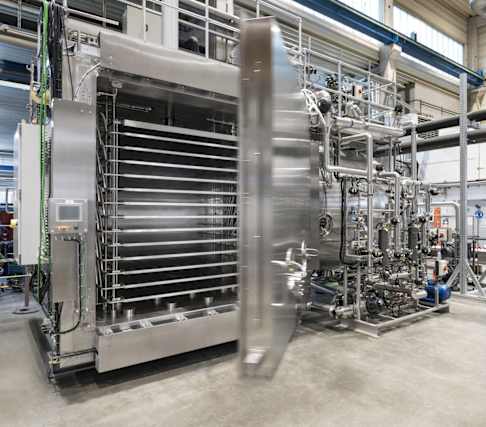
RESOURCE- EFFICIENT FREEZE DRYING WITH ECO MODE.
GEA.com
The current and universal issue that affects every organization and process is the environment. GEA takes the health of the planet very seriously and, like its customers, other pharmaceutical companies and peers, has committed to sustainability targets. In terms of greenhouse gas reduction, for instance, plans are in place to significantly reduce Scope 1 and 2 (direct and indirect emissions controlled by the company) emissions by 2026; this will be increased to 80% by 2030, by which time Scope 3 emissions (not controlled by the company) will be lowered by 27.5%. The company aims to achieve Net Zero by 2040.
Innovation targets GEA fully understands that product and process innovation must improve the sustainability of its equipment, such as emissions derived from steam, electricity and refrigerant leakage. Operationally, the
power needed to drive a freeze dryer’s refrigeration system accounts for more than 60% of its total energy consumption. In addition, long processes exacerbate energy consumption. Not to mention that vacuum systems and control are extremely inefficient. As Thomas Beutler, Senior Director of Lyophilization Technology Management, notes: “Using a nitrogen bleed to regulate the chamber pressure is like driving a car at full throttle and controlling its speed with the handbrake!”
Some solutions are already available to help users and operators achieve their sustainability goals, such as the LYOAIR® cooling system, which uses natural refrigerants, and novel concepts such as microwave-assisted and atmospheric spray freeze-drying. But when it comes to process optimization in the world of lyophilization, there’s more to come.
Freeze dryers are typically associated with high levels of energy consumption; to counteract this problem, GEA Pharma & Healthcare has introduced LYOVAC ECO Mode, which optimizes the process through dynamic condenser temperature control and mushroom valve regulation.
2 LYOVAC® ECO Mode.
A long-established and trusted tool in this environment is computational fluid dynamics (CFD) simulation. Using a virtual benchtop freeze dryer, a range of test inputs and process conditions can be assessed and reviewed.
Some examples include plant configuration (geometry) and process conditions, including sublimation flow rates, refrigeration temperature, and/or the ice thickness on condenser coils. By examining performance indicators such as chamber pressure, the distribution of ice growth rates and the lowest controllable parameters, problems such as bottlenecks and causes of pressure loss can be identified and remedied.
To cite a specific example, a sublimation rate-limiting issue was located with the mushroom valve of a LYOVAC® FCM 700-D. CFD analysis revealed that simply changing the size of the valve could eradicate this problem. By optimizing the design, not only could the peak velocity be reduced, but the lower minimal controllable pressure also decreased the risk of “choked flow.” In summary, the design changes that resulted in lower velocities near the condenser coils contributed to a lower likelihood of ice- related blockage and a more uniform ice growth rate.
Another example highlighted the effect of different fluid condenser temperatures during processing. At a sublimation rate of 35 kg/h and a chamber pressure of 0.067 mbar, the peak velocity was recorded at 710 m/s when the temperature was set at –90 °C. The lower pressure at these conditions meant that the condenser coils were susceptible to very high ice growth rates near the mushroom valve.
However, by changing the temperature to –55 °C, the peak velocity could be reduced to 460 m/s, which negated this risk. CFD showed that the flow around the product shelves was almost unaltered (despite the large change in condenser temperature) and the uniformity of sublimation remained constant.
Other examples have helped to overcome issues regarding non-homogeneous ice growth rates. Temperature modulation affects vapor velocity rates and implements a standard vapor speed at different sublimation levels. All of which prove the ingenuity and expertise of GEA scientists. But they felt that there was a better yet undefined solution. A universal methodology was required that took a more holistic approach to proactively making the process of pharmaceutical freeze drying more sustainable and more energy efficient.
LYOVAC® ECO Mode: a solution for tomorrow With a focus on saving both energy and media, GEA’s new LYOVAC® ECO Mode combines dynamic condenser temperature control and mushroom (chamber/ condenser) valve regulation to optimize the lyophilization process.
Thomas Beutler explains: “Our new algorithm changes the set point of both the fluid condenser temperature and the position of the mushroom valve during drying. What this means is that there’s no longer an actual fixed temperature for the condenser; it’s optimally matched to the ongoing process and no colder than necessary.”
In addition, the mushroom valve opening position can optionally be used as an additional control mechanism … as well as the nitrogen inflow rate. This allows the freeze dryer to reach the same chamber pressure but with warmer condenser coils. As a result, less nitrogen is needed to control the pressure. The system can also be augmented with a virtual sublimation sensor if required (Figure 1).
Figure 1: CFD analysis showing the effects of varying the mushroom valve aperture.
With a wealth of experience in process optimization, GEA has been helping its global customers to overcome production hurdles for decades.
Planting the seeds. up to
60% energy reduction
“With 20 °C warmer condenser coils, we can save up to 60% of the energy used for cooling,” adds Thomas, “with no expected adverse effect on the freeze dryer’s ability to handle existing product recipes.”
3 LYOVAC® ECO Mode.
A series of initial tests was done using a LYOVAC FCM 2 to compare the coefficient of performance (COP) and process energy consumption of the ECO Mode with the theoretical value of a two-stage reciprocating compressor (R507). Using 3% mannitol as the test product and taking an average of five trial runs, the results were impressive (Figure 2).
In both situations (with a constant condenser temperature of less than –70 °C for the classic mode and a dynamic condenser temperature not colder than –53°C for the ECO Mode) and using pressure rise measurement (PRM) to determine the end of primary and secondary drying, the processing times for both the classic and ECO Mode were very similar.
No effect on residual moisture was observed, and it was calculated that more than 50% of the cooling capacity could be saved during primary drying (PD). During secondary drying (SD), the energy savings were lower due to the lower set pressure. Yet, because of the COP, the electrical power savings in the fluid compressor were significantly higher.
Further trials were then done with 5% sucrose (Figure 3). Again, based on an average of five runs, the ECO Mode process time was slightly longer, but, like the mannitol tests, more than 45% of the cooling capacity could be saved during PD. Likewise, significant electrical energy savings could be made with no influence on residual moisture.
Putting theory into practice.
Figure 2: ECO Mode energy savings during trials run with 3% mannitol.
Figure 3: ECO Mode energy savings during trials run with 5% sucrose.
4 LYOVAC® ECO Mode.
After the extensive in-house tests described previously were done, GEA then conducted further experiments on a production-scale freeze dryer.
5 LYOVAC® ECO Mode.
Using a LYOVAC® FCM 500-D machine with a shelf area of 22.3 m2 and a total run time of 46.55 h, energy savings of 401.32 kWh were recorded, equating to an electrical power reduction of 21.1%. These impressive results were submitted to TÜV Rheinland for external inspection and assessment against recognized international standards.
Proven Results at Production Scale Acting as a third-party validator, TUV concluded that, in accordance with the DIN EN ISO 14021:2021-10 standard, the TYPE II “ADD BETTER” ECOLABEL developed by GEA Lyophil GmbH for the use case: “LYOVAC ECO Mode” is reasonable, transparent and appropriate.
They also noted that the submitted data was “coherent and comprehensible,” and could be used in communication, marketing, or documentation to show customers and stakeholders that the environmental and/ or technical claims have been verified by an impartial authority.
“Independent substantiation provides external assurance that our energy saving claims are consistent and scientifically sound,” said Thomas Beutler. “Being able to use the term ‘Validated by TÜV Rheinland’ gives our customers confidence that ECO Mode’s sustainability benefits are not just internal estimates; they have been independently verified.”
“It reflects that this retrofit-compatible technology delivers clear, technically thorough, and measurable improvements in efficiency and environmental performance with no adverse effect on the final product.”
LYOVAC® ECO Mode is retrofit-compatible, making it accessible to existing users looking to reduce their environmental footprint — and transform the future of planet-friendly freeze drying — today.
* The Add Better label relates to the serial product GEA LYOVAC ECO Mode, released in September 2025.
Third-party validation confirms ECO Mode’s sustainability credentials.
The Add Better label showcases GEA solutions that are significantly better than their predecessors when it comes to operational excellence and environmental impact (with no adverse effect on product quality). They represent the organization’s most resource-efficient solutions and demonstrate in a tangible way that a specific model is more cost-effective and environmentally friendly to run than previous ones.
Further information GEA Pharma & Healthcare lyophil@gea.com gea.com/contact
https://www.youtube.com/GEAPharma https://www.linkedin.com/showcase/gea-pharma-&-healthcare/ https://www.facebook.com/GEAPharma
GEA.com
© GEA Lyophil GmbH 07/2026. All rights reserved. Subject to modifications. ALUS®, LYOAIR® & LYOVAC® are registered as trademarks in several countries worldwide.
GEA Lyophil GmbH Siemensstrasse 9, 50189 Elsdorf, Germany
Tel +49 2274 93 80 99-0 lyophil@gea.com gea.com/contact