New oncology manufacturing line delivers higher yields and shorter cycle times.
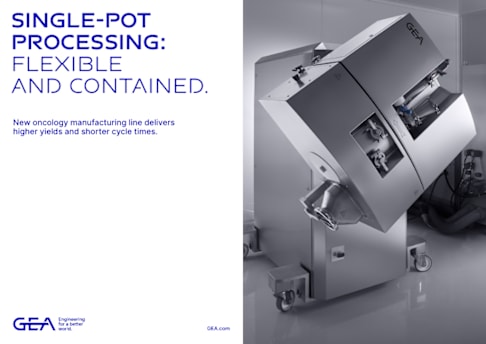
A single-pot process is contained. No transfers are required between process steps except to load the raw materials and unload the dry granules...
GEA.com
SINGLE-POT PROCESSING: FLEXIBLE AND CONTAINED.
New oncology manufacturing line delivers higher yields and shorter cycle times.
At the same time, the health and protection of operators involved in manufacturing drugs for oncology and hormone applications are being put under an increasingly intense spotlight. As such, never has it been more important to select and implement the most appropriate equipment for such tasks.
At the heart of OSD form production is granulation. With high-shear granulation technology at its core, single-pot processing relies on the application of a vacuum within the bowl to dry the wet mass. This technique allows pharmaceutical compounds to be dried at very low temperatures and, even if organic solvents are used during the granulation process, an efficient recovery system means that environmental exhaust levels are minimal.
In addition, because of its very nature, a single- pot process is contained. No transfers are required between process steps except to load the raw materials and unload the dry granules (using BUCK® high containment split-valve technology). This is not only beneficial for the operators, protecting them from potent products, but also to protect the
products from external influences such as heat, light or moisture. Specific solutions are available for product loading and discharging that achieve the desired level of containment for the whole process.
Furthermore, a single-pot processor combines the advantages of a high-shear granulator with a minimal surface area and the built-in facility of clean-in- place (CIP) to offer extremely fast changeover times. The available drying techniques for a single-pot processor are vacuum drying, gas-assisted vacuum drying (Transflo), microwave drying and swinging bowl. By equipping the machines with all these techniques, the most suitable drying parameters can be selected to ensure high yields and short cycle times.
Using microwaves, for example, significantly reduces the drying time and enables the bowl temperature to be controlled to prevent the product from sticking to the vessel wall. The single-pot concept inherently ensures contained processing by avoiding product transfers and allowing the unit operations of mixing, granulation and drying to be done in one machine..
SINGLE-POT PROCESSING: FLEXIBLE AND CONTAINED. As active pharmaceutical ingredients (APIs) and new chemical entities (NCEs) become increasingly potent, containment is now a fundamental aspect of oral solid dosage (OSD) form production.
2 Single-Pot Processing: Flexible and Contained.
In the UK, COSHH rules state: “It is the first duty of the employer to protect (the health) of its employees.” Even though the regulatory situation differs from country to country, this statement should be seen as general guidance when handling potent substances. Given that approximately 30% of all people in Western societies will develop some form of cancer during their lifetime, if one of these had been exposed to a carcinogenic substance whilst working for a pharmaceutical company, there is the potential for a legal claim against the company. This could result in high-cost compensation and very bad publicity unless the company can prove that the employee had been protected using the best available technology
Contained Solid Dosage Production To cite an example, when GEA supplied a complete oncology manufacturing line to a customer in India, they didn’t just ensure the health and safety of the operators — complying with internationally recognized standards — the company also increased yields, reduced production cycle times and implemented an ultimate containment solution.
Key Considerations Planning to use high containment equipment to improve its solid oral dosage
form production processes for highly potent drugs, the customer approached GEA for help with several key technology requirements. They needed processing units that could handle their occupational exposure band (OEB) 3 and 4 drugs without exposing their operators to any health or safety risks. In an ideal world, operators would not be exposed to a single harmful molecule. In reality, however, this is simply not possible.
Three main factors dictate how much containment is required and, therefore, which method of containment is most appropriate: the nature and potency of the API; the type of process to be done; and the working environment of the operators.
With this project, all transfers to the production environment had to be effectively contained to avoid contamination of the product or the surrounding atmosphere. At the end of the process — and during product changeover — a fully validated CIP cycle was required to avoid any product contact. The whole process had to be compliant with current good manufacturing practice (cGMP) requirements and, not surprisingly, any loss in (expensive) product yield had to be avoided. The following points illustrate important criteria that were examined during the vendor selection process.
Product: The potency of a substance is generally characterized by the occupational exposure limit (OEL) or the acceptable daily intake (ADI). The ADI describes the absolute amount of a specific drug substance that an operator can absorb without a negative health effect. Similarly, the OEL describes the maximum concentration of a drug substance that can be tolerated in the air of the production room.
Containment Risks: During most of the manufacturing process, APIs remain within airtight machines or vessels. The main risk of material loss occurs whenever a connection between those pieces of equipment needs to be made or broken, when a sample needs to be taken and when the machines need to be cleaned at the end of a manufacturing campaign.
Cross-Contamination: Common ways to reduce the level of cross-contamination in multi-product facilities include separate production rooms, air locks and pressure cascades. These are perfectly appropriate for less critical products; but, when highly potent substances are handled, strict containment is the only way to protect both operator health and the integrity of other products.
Containment Regulation.
3 Single-Pot Processing: Flexible and Contained.
Taking all these factors into account and, after suitable consideration, GEA recommended the use of two single-pot processors in a set-up that met all the key requirements: for the development laboratory, an UltimaPro 10 (10 L processing bowl) equipped with Hicoflex® technology for containment; and for production, an UltimaPro 75 (75 L processing bowl) equipped with Hicoflex® and BUCK® MC valves. Both single-pot processors were equipped with all the available drying techniques, including microwave, to ensure flexible processing, higher yields and shorter cycle times.
Customer Benefits GEA was able to supply the company with a complete oncology manufacturing line. The hardware solutions provided — particularly the split valves and the tablet press — represent the cutting edge when it comes to handling highly potent APIs. The entire
project was managed in-house, beginning with a risk analysis regarding the amount of containment required, progressing through the overall design of the building and solution to installation and start-up.
In addition, it was also managed in situ, in India, by local colleagues; only key components, such as the split valves, tablet press and single pot processor, were sourced from Europe. By choosing the UltimaPro 10 and 75, equipped with all the available options, and with Hicoflex® technology and BUCK® MC valves, the customer has ensured that it will be able to produce their OEB 3 and 4 drugs in a safe, cGMP-compliant environment and guarantee maximum yields with reduced cycle times.
Key Components.
Further information GEA Pharma & Healthcare pharma@gea.com gea.com/contact
A Hierarchy of Control Measures for Effective Containment • Elimination at the source • Substitution with a less hazardous material or form
• Reduction of the quantity below critical limits
• Engineering controls to prevent intolerable operating staff exposure (contained handling)
• Administrative controls • Use of personal protection equipment (PPE).
The company’s President of Operations commented:
“Dealing with highly potent solid oral dosage forms, we were looking for processing units that were safe, cGMP-compliant and protected the health and safety of our operators. We also wanted to maximize yields, prevent expensive product loss and reduce cycle times. These were the key factors that influenced our decision to purchase this technology and work with GEA.”
4 Single-Pot Processing: Flexible and Contained.
https://www.youtube.com/GEAPharma https://www.linkedin.com/showcase/gea-pharma-&-healthcare/ https://www.facebook.com/GEAPharma
GEA.com
© GEA Process Engineering nv 2025. All rights reserved. Subject to modifications. BUCK® & Hicoflex® are registered as trademarks in several countries worldwide.
GEA Pharma & Healthcare GEA Process Engineering nv
Keerbaan 70, B-2160, Wommelgem, Belgium Tel +32 2 350 1211
pharma@gea.com gea.com/contact